
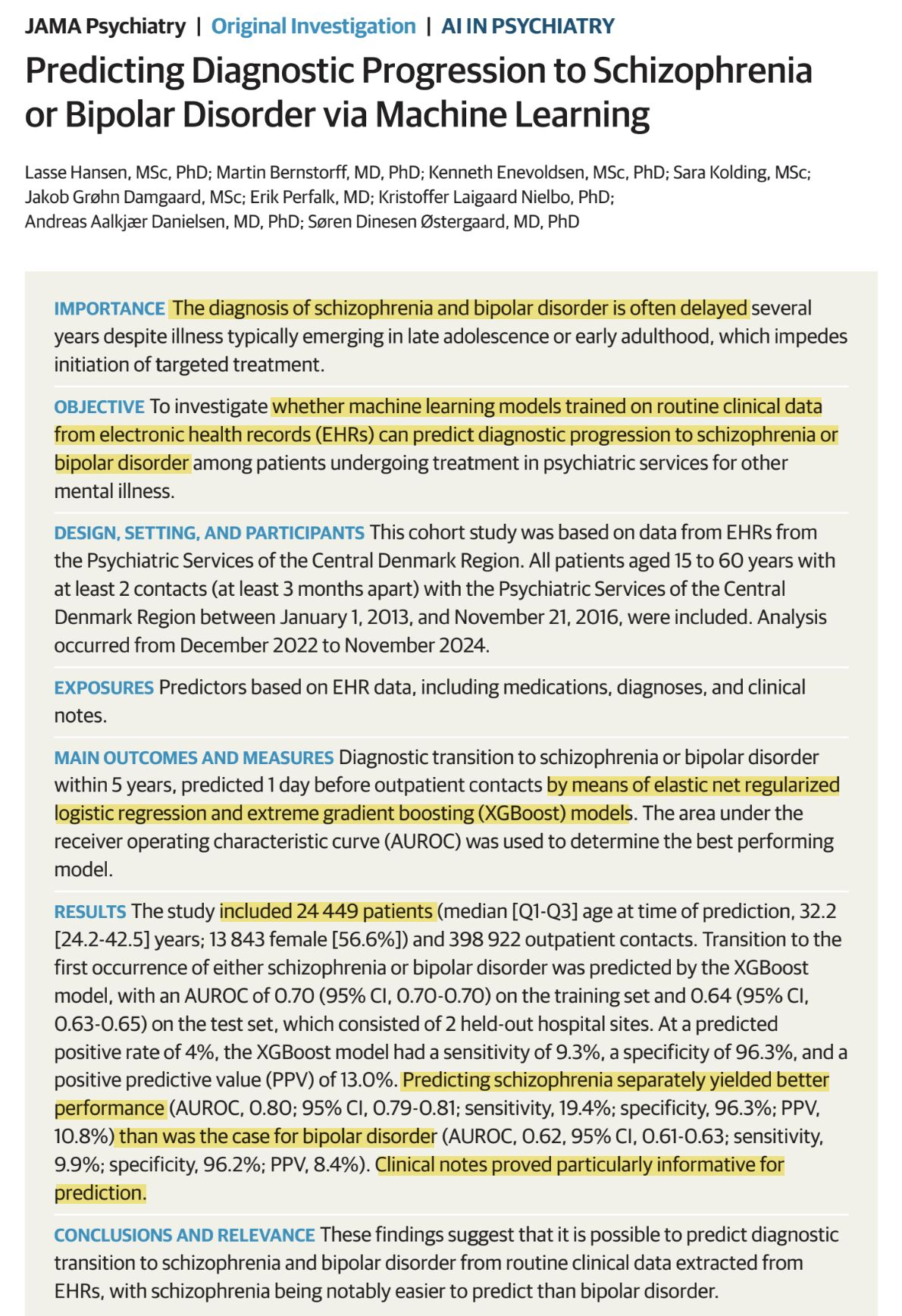
A JAMA Psychiatry 2025 study says: machine learning isn’t (yet) ready to predict the onset of schizophrenia or bipolar disorder.
Few interesting points:
✅ (1) Schizophrenia prediction outperformed bipolar prediction.
Why? Schizophrenia onset is often much more uniform, while bipolar onset is more heterogeneous, making ML’s job that much harder.
✅ (2) Only routine EMR data was used; no new data was collected.
Interestingly, only the free-text had predictive value. Including the structured data did not make any meaningful improvement.
✅ (3) Positive predictive value (PPV) was too low, across the board.
Even though the model showed good discriminatory power for identifying potential cases of schizophrenia (AUROC = 0.80), it wasn’t very good at being right when it made a positive prediction (PPV only 10.8%).
This highlights a common challenge in low-prevalence conditions — high false positives despite good overall discrimination.
Much more wood to chop here!
📚 TL;DR: Earlier diagnosis is critical. But ML is not ready for this yet. We need more data, better models, and more computation horsepower.
Yet with the rapid pace of improvements on all of these fronts, I have no doubt we’ll see this solved, soon!