
Before rideshare applications became popular, getting from point A to point B was time-consuming and expensive. Hailing a taxi involved flagging down a cab on a busy city street, watching the meter rack up charges, then digging for pocket change to pay the fare.
Now, we have Uber, Lyft, and more. These apps offer a convenient, inexpensive way to get a ride using a digital platform that activates the value of underutilized cars and drivers. Similarly, Airbnb satisfies our short-term housing needs by offering a cheaper way to stay in someone’s spare bedroom and home.
All of these companies have one thing in common: they have built a digital platform to activate the untapped potential of existing resources.
This isn’t new, of course. Craigslist, which launched back in 1995, connected the dots between unmet demands and underutilized supply of cars, home rentals, and more.
It was a crude system, but it worked.
The game-changers in the shared economy today, however, are companies that have designed their technology to leverage a connected ecosystem of customers, vendors, and partners to do three things: reduce cost, improve efficiency, and deliver predictable results with high customer satisfaction.
Also — and significantly — these companies have focused on developing protocols for quality control, transparency (customer reviews, ratings, etc.), rigorous oversight, and customer support.
Peer support in healthcare activates the untapped potential of patients’ knowledge and their ability to empathize with others going through similar experiences.
And now digital platforms are helping peer mentorship programs optimize, standardize and scale — while delivering clinically efficacious results.
The peer support revolution
From the outset, three models of peer support have existed, each with its own advantages and disadvantages.
1. In-person. The most common method for connecting patients to each other is simple: people with similar health concerns meet in-person on a given day to talk about their condition. A professional like a social worker often moderates.
But attending a support group like this requires having transportation, having the ability to travel, and being available at the specific meeting day and time. Privacy is obviously lost, and comfort in publicly sharing your story is required.
2. Telephonic groups. Another less common peer support method uses a single telephone line to connect a group of patients. These are typically moderated by a professional, too.
This obviates the need for travel, but requires meeting at a fixed day and time. And there is a natural limit to how much individualized support someone can receive.
3. Internet-enabled support. With the Internet, social networking sites, and mobile phones, a multitude of online health forums (Facebook groups, etc.) have given patients a third option to connect.
This has dramatically opened up the lines of communication between people.
These are mostly text-based interactions, so the quality of the connection is limited. No real-time exchanges. And the prevalence of unvetted, unprofessional advice-givers is quite commonplace.
All three of these peer-to-peer support modalities are used together in varying degrees in different clinical settings today.
Drawing Parallels
Like Lyft or Airbnb, peer-to-peer support in healthcare expands the capacity of an industry (healthcare), and taps unused resources (patients and their lived experiences) to shepherd others experiencing similar health concerns towards success.
But, like Craigslist, this generation of approaches and early tech tools generally lack the necessary protocols, processes, and oversight to allow peer-to-peer support to predictably deliver on outcomes.
Thus — the potential of peer support as a clinically efficacious intervention remains unrealized.
The good news is, this is changing.
First, the evidence
Earlier this year, at the Society for Behavioral Medicine, I had the privilege of hearing Susannah Fox, the former CTO of HHS, speak about “Building the evidence base for peer health advice.”
Her first slide captured the promise of peer support:
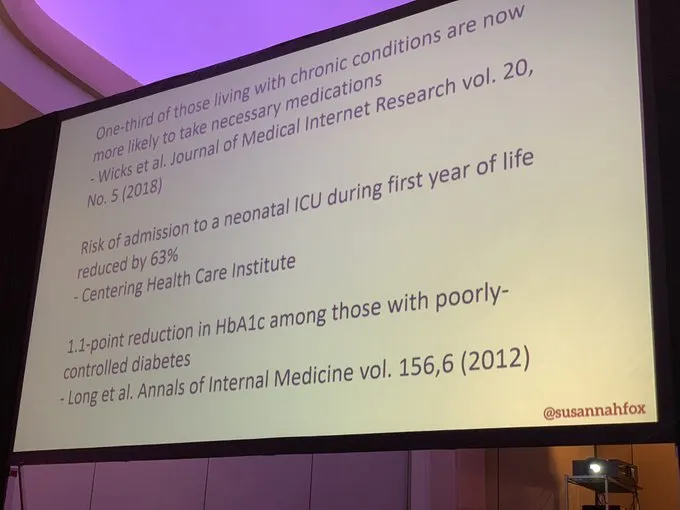
Susannah’s 1st slide of “Building the evidence base for peer health advice.” Credit: my iPhone :)
Multiple randomized clinical trials (like here and here) have demonstrated how structured, carefully tailored peer mentoring improves self-efficacy, self-management skills, medication adherence, and clinical outcomes.
Peer mentoring can help reduce ED visits, hospitalizations, and social isolation, too.
The potential for peer mentoring to deliver impressive results has been clearly demonstrated.
But healthcare has still been slow to integrate peer mentoring as a clinical intervention.
Now, the technology
The National Institutes of Health (NIH) has supported the development of advanced technology platforms to translate academically-validated peer mentoring programs into powerful chronic disease management programs that are now being used by innovative hospital systems and health plans across the country.
These peer-to-peer mentoring programs are able to get buy-in from multiple stakeholders (physicians, nurses, population health leaders, social workers, case managers, and senior leadership) by being easy-to-use, easy-to-integrate, HIPAA-compliant, and, most importantly — demonstrating an ability to deliver measurable improvements in clinical and operational outcomes.
Technology-enabled peer mentoring is driving results efficiently and effectively by:
- utilizing existing data to identify successful patients (i.e., ‘peer mentors’)
- leveraging e-training approaches to train and evaluate peer mentors
- matching those peer mentors to patients in need based on shared attributes (e.g., clinical characteristics, language, culture, and more)
- reducing the operational burden of 1-on-1 longitudinal contact between patients and peer mentors
- streamlining communication between peer mentors and clinical staff to address the social+behavioral determinants of health (S+BDoH)
- allowing critical oversight and management
- capturing data to systematically demonstrate impact
Finally, the results
Tech platforms that can achieve all of this are transforming the perception that ‘peer support’ is just a feel-good, nice-to-have to ‘peer mentoring’ being an evidence-based intervention that drives sustained improvements in clinical outcomes across multiple diseases.
Also, platforms like these are helping to address the healthcare worker shortage by adding powerful allies — successful patients — to help engage patients most in need. By activating the positive outliers in the poorest zip codes to help others like them, peer mentor platforms are helping to address the deeper social + behavioral determinants of health (S+BDoH).
Most importantly, if the platforms and associated overall programs are well-designed, they can be a powerful conduit to help people connect in deeper and more authentic ways, such that core challenges surface and sustainable solutions are effectively developed and implemented.