
The Greenwood et al. study came out in 2020. It was a sensation. The Supreme Court even cited it:
“For high-risk Black newborns, having a Black physician more than doubles the likelihood that the baby will live.” NOT SO FAST…
First, let’s establish:
- Does health inequity exist? Yes.
- Does health inequity matter? Yes.
- Does bad science ‘proving’ health inequity help? NO.
Is ‘bad science’ what happened here?
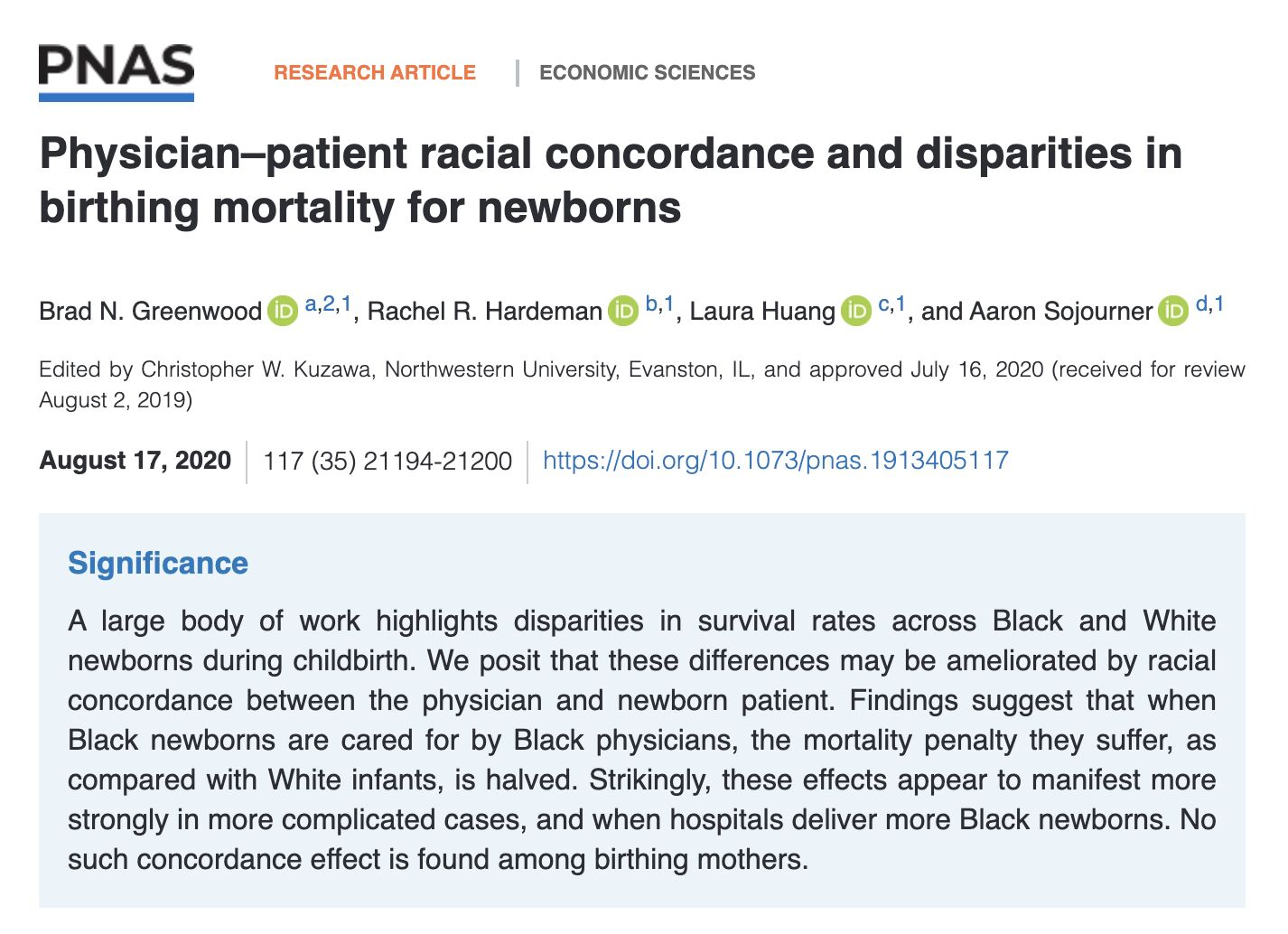
In 2020, Greenwood, et al. published a paper in the Proceedings of the National Academy of Sciences (PNAS) titled: “Physician-patient racial concordance and disparities in birthing mortality for newborns.” [1]
The results are large in magnitude, significant, and surprising.
The paper got sensationalized, even cited by Chief Justice Ketanji Jackson in her dissent against racial preferences in college admissions.
There were doubters, of course, who questioned the methods, interpretation, and even intentions. And honestly, they had some good points. [2]
Then, Borjas, et al. in 2024 went even further and re-did the entire study. [3] In particular, they included a previously omitted variable: low birth weight.
This essentially nullified the core results of the original study.
Side note: Low birth weight correlates with high mortality, and more low birth weight black babies were taken care of by white pediatricians. Classic ‘omitted variable bias.’
But look, science gets revised. That’s fact.
And it should, that’s the scientific process.
Better methods, more data, smarter analysis. Cool.
That’s what happened here.
Again, this happens, no harm — that’s science.
But, a nonprofit organization just made a FOIA (“Freedom of Information Act”) request about the original study PUBLIC. They got back e-mails between the authors, prior drafts, and even internal comments on those drafts.
Some of those comments included a call out to omit key results that would “undermines the narrative.”
— and that’s where the optics are terrible, if true.
I don’t care to bash them, and I think this story will play out as it should.
But this is a stark reminder, once again, that science needs more objectivity, more transparency, more honesty.
Otherwise, we lose on many fronts.
There are many studies with serious methodological problems, overstated causal claims, and/or a complete inability to be replicated.
We can’t afford to win a battle, and lose the war.
The publish or perish incentives in academia are twisted. The peer-review process has many well-documented problems, too. And, with growing distrust, politicization, and polarization, there’s an undeniable push to use science to justify narratives and pre-conceived notions.
We — now more than ever — need to make sure science isn’t here to just affirm what we already believe to be true. We need science to be a trusted vehicle to help us find objective truths, even the inconvenient ones.
References
[1] Original paper: doi.org/10.1073/pnas.1913405117
[2] WSJ Opinion: Justice Jackson’s Incredible Statistic
[3] Updated analysis paper: doi.org/10.1073/pnas.2409264121
[4] If you are really, really interested, message me.