As part of my PhD thesis, I spent years studying what happens when you force health plans to publish quality data. That history is repeating itself again now.
The assumption was straightforward: transparency would drive change. Patients would compare quality scores, choose “better” plans, and the shift in market share would cause plans to invest in becoming “better” plans.
Turns out, that’s not what happened.
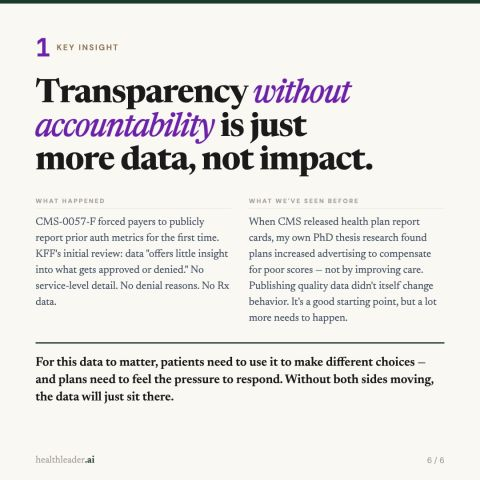
My research found that plans increased advertising to compensate for poor scores. They managed perception — not performance. And, perhaps not surprisingly, patients didn’t significantly respond.
Publishing quality data was a good starting point, but a lot more needed to happen to actually drive real change.
On March 31st, history is starting to repeat itself.
CMS-0057-F forced payers to report prior authorization metrics publicly for the first time — volumes, approval rates, turnaround times.
KFF’s initial review? The data “offers little insight into what gets approved or denied.” No service-level detail. No denial reasons. No Rx data.
I even had a hard time finding this data for all the plans I work with.
Overall, approval rates look high in aggregate (~80-95% depending on plan type). But without granularity, there’s no way to tell whether that reflects appropriate gatekeeping or unnecessary burden on patients and clinicians.
But it goes beyond more data. For real change, we need more clarity, comparability, and consequences. For it to matter, all sides have to move:
- Patients need to use the data to make different choices.
- Providers need to use the data to make different choices.
- Plans need to feel the pressure to respond.
Without demand-side action AND supply-side accountability, prior auth transparency follows the same path as quality report cards.
If history is our guide, more transparency won’t automatically mean better outcomes. That will take work.