
For health plans launching 2026 Benefit Design, this is a must-read paper: “The Health Costs of Cost-Sharing.”
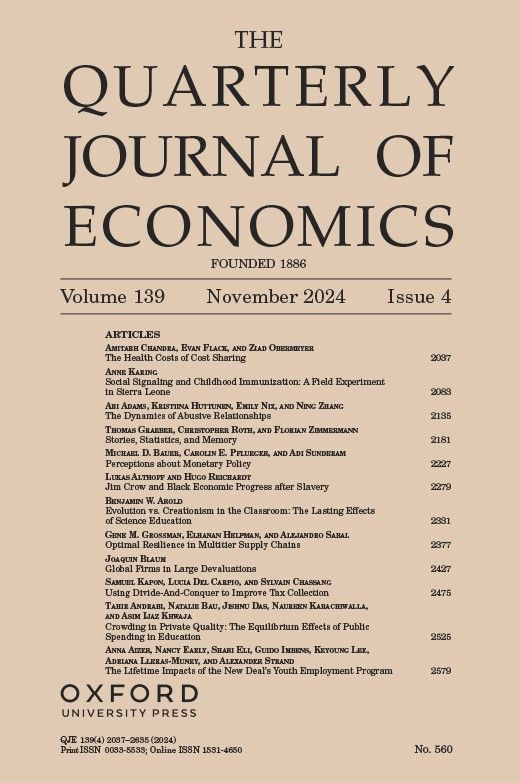
Side note: it’s very impressive whenever top-tier pure econ journals like QJE (Quarterly Journal of Economics) publish health econ papers — signal of very strong quality.
The ideal question we want to answer
“What happens when patients suddenly stop taking their medications?”
This is a HARD question to study. Why? Getting IRB approval for a randomized clinical trial to answer this question is impossible — i.e., we ethically can’t randomize people to stop taking their medications.
This study’s clever solution is to take advantage of where this is happening naturally — a ‘natural’ experiment. (This circumvents the ethical dilemma.)
🧪 What’s the natural experiment?
- Medicare Part D pays $2,500 in drug costs per year.
- When you first enroll into Medicare at age 65, it’s based on your birthday month when you turn 65.
- As a result, if you are born in January, the $2,500 has to stretch the whole year.
- If you were born in July, it would only have to stretch 6 months.
- But in all cases, once you pass the $2,500 budget (paying 25% of your drug costs), you immediately jump to paying 100% of your drug costs. This is the infamous ‘donut hole’ conundrum.
This natural variation, based on your birth month, allows the researchers to ask, and answer, this key question:
What happens to those who ‘randomly’ end up with higher copays?
The answer
-
“Those facing smaller budgets consume fewer drugs and die more: mortality increases 0.0164 percentage points per month (13.9%) for each $100 per month budget decrease (24.4%).”
-
“Contrary to the predictions of standard economic models, high-risk patients (e.g., those most likely to have a heart attack) cut back more than low-risk patients on exactly those drugs that would benefit them the most (e.g., statins).”
-
“Finally, patients appear unaware of these risks. In a survey of 65-year-olds, only 1/3 believe that stopping their drugs for up to a month could have any serious consequences.”
But aren’t there a lot of alternative explanations?
Yes — there are a LOT of caveats, and this is the beauty of this study. They 100% went overboard in positing and then refuting many potential alternative explanations.
And, as we’d expect, they do a tremendous job here. This isn’t surprising given this was published in QJE.
Key takeaways for me
→ 1️⃣ Medicare Part D onboarding policies are worth re-evaluating (donut holes, copays, fixed budgets). For now, health plans need to be aware, and adjust. I’m curious to learn more about what health plans are doing here.
→ 2️⃣ It’s critical we educate patients (and physicians) on the mortality risks associated with missing medications.
As co-author Ziad Obermayer succinctly summarized: “Copays kill.”
Read the paper for more details.
References
- Gated (QJE): The Health Costs of Cost-Sharing — Quarterly Journal of Economics, Vol. 139, Issue 4
- Free (NBER working paper): nber.org/papers/w28439